Work through 2026 AMC 8 Problem 25 on combinatorics and geometry with a written solution, hints, and a visual explanation.
Counting & ProbabilityLevel 5 · Final stretch
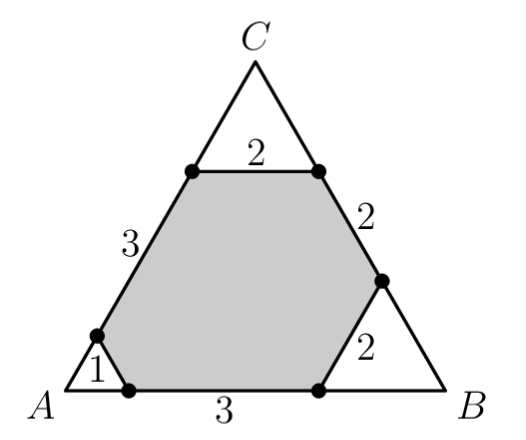
In an equiangular hexagon, all interior angles measure 120°. An example of such a hexagon with side lengths 2, 3, 1, 3, 2, and 2 is shown below, inscribed in equilateral triangle ABC. Consider all equiangular hexagons with positive integer side lengths that can be inscribed in △ABC, with all six vertices on the sides of the triangle. What is the total number of such hexagons? Hexagons that differ only by a rotation or a reflection are considered the same.
Diagram 1
A. 4
B. 5
C. 6
D. 7
E. 8
Hints
Picture inscribing the hexagon as cutting a small equilateral triangle off each corner of the big triangle.
Let the three corner cuts be a, b, c — write inequalities so that every hexagon side (both the cut sides and the sides lying on the triangle) comes out as a positive integer.
Count the unordered triples {a, b, c} satisfying those inequalities, since rotating or reflecting the triangle makes some triples equivalent.
Read the step-by-step solution
Answer: E · 8
Inscribing = cutting three corners
Triangle ABC has side 6 (each side reads 1 + 3 + 2 = 6 in the figure). Placing the hexagon cuts a small equilateral triangle off each corner. If the cuts at A, B, C are a, b, c, then the three hexagon sides lying on ABC are 6 − a − b, 6 − b − c, 6 − c − a, and the three slanted sides are a, b, c.
Every length is a positive integer
Each cut a, b, c must be at least 1 (the six vertices lie strictly on the sides), and each flat 6 − a − b, 6 − b − c, 6 − c − a must be at least 1. So every pair of cuts adds to at most 5.
a+b ≤ 5, b+c ≤ 5, c+a ≤ 5
Count the corner triples up to symmetry
Rotations and reflections of the triangle permute a, b, c, so count unordered triples {a,b,c} with each pair ≤ 5: {1,1,1}, {1,1,2}, {1,1,3}, {1,1,4}, {1,2,2}, {1,2,3}, {2,2,2}, {2,2,3} — 8 hexagons in all.