Work through 2026 AMC 8 Problem 21 on probability and random walks with a written solution, hints, and a visual explanation.
Counting & ProbabilityLevel 5 · Final stretch
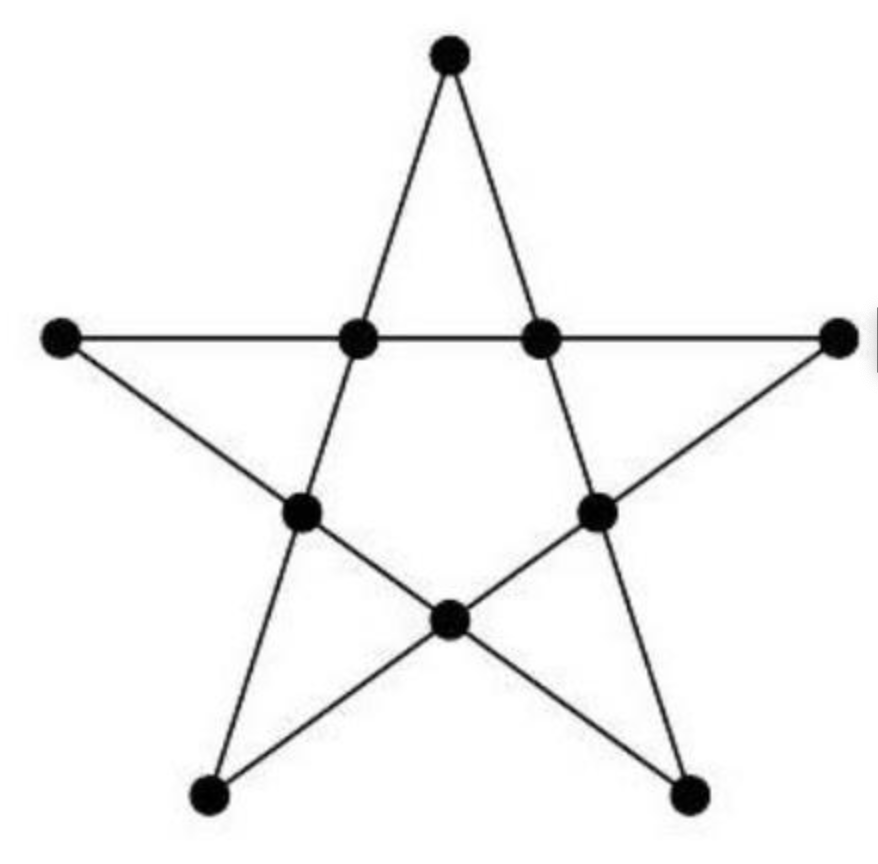
Charlotte the spider is walking along a web shaped like a 5-pointed star, shown in the figure below. The web has 5 outer points and 5 inner points. Each time Charlotte reaches a point, she randomly chooses a neighboring point and moves to that point. Charlotte starts at one of the outer points and makes 3 moves (re-visiting points is allowed). What is the probability she is now at one of the outer points of the star?
Diagram 1
A. 1/5
B. 1/4
C. 2/5
D. 1/2
E. 3/5
Hints
By symmetry, you only need to track whether Charlotte is on an outer point or an inner point after each move — not which specific point.
Figure out the probability of moving outer→inner versus inner→outer/inner, based on how many neighbors each type of point has.
Track the probability of being on each type of point move by move, from move 1 through move 3.
Read the step-by-step solution
Answer: B · 1/4
Two kinds of points
By symmetry, track only whether Charlotte is on an Outer tip or an Inner point. An outer tip's 2 neighbors are both inner, so she always steps inward. An inner point has 4 neighbors — 2 outer and 2 inner — so she goes outward or stays inward with probability 1/2 each.
After move 1
She starts on an outer tip, so her first step is forced inward. Now she is certainly on an inner point: P(outer) = 0, P(inner) = 1.
After move 2
From an inner point she reaches an outer tip with probability 1/2 and another inner point with probability 1/2. So P(outer) = 1/2 and P(inner) = 1/2.
After move 3
To end on an outer tip she must be on an inner point before this move (probability 1/2) and then step outward (probability 1/2). P(outer) = 1/2 × 0 + 1/2 × 1/2 = 1/4.